
MOXO indicators
Beyond the four attention indices, MOXO reports three indicators that describe the quality and character of the test result itself. They help the clinician judge how far the scores can be relied on before interpreting them: whether the responses were consistent, whether the client made a genuine effort, and how closely the overall profile resembles typical patterns. These indicators don't measure attention. They give context for reading the attention scores.
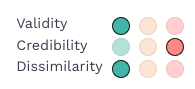
- Validity – Assesses whether the individual's responses were consistent and reliable. An invalid result suggests a likelihood of random responses, regardless of the task rules.
- Credibility – Measures the individual's genuine effort to perform well. In older adolescents and adults, a non-credible result may indicate an intentional attempt to fake poor attentional performance. In children, it may reflect a lack of effort or insufficient understanding of the task.
- Dissimilarity – Highlights the uniqueness of an individual's cognitive profile by showing how much it diverges from typical patterns.